The headers#
Every response gets the same set, built by one shared function. This page shows the set, the default Content-Security-Policy exactly as the code defines it, and the rule behind each header. To change the policy itself, see Customizing the CSP.
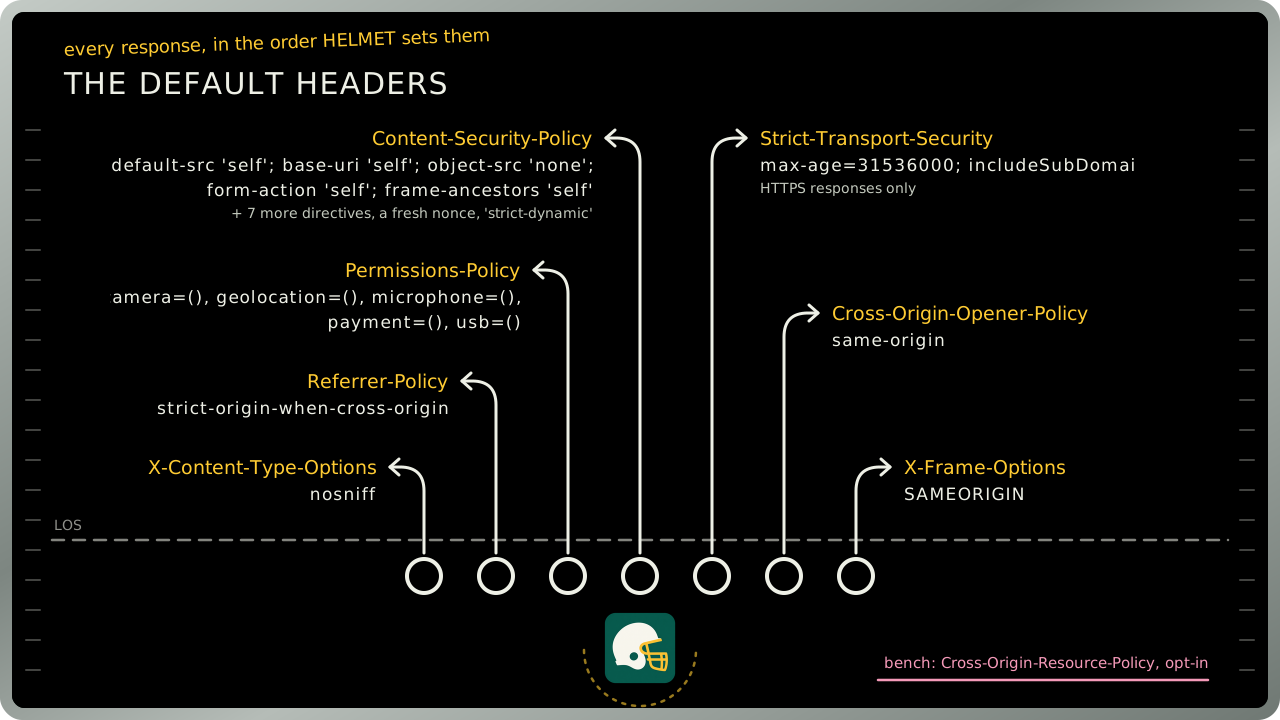
The play is read from src/Headers/SecurityHeaders.php: seven routes, one per default header, drawn in the order HELMET sets them. Cross-Origin-Resource-Policy waits on the bench until you opt in. With reduced motion on, you get the finished play.
The set#
| Header | Value |
|---|---|
Content-Security-Policy |
the WayneUI default policy, plus a per-request nonce and strict-dynamic |
X-Content-Type-Options |
nosniff |
X-Frame-Options |
SAMEORIGIN |
Referrer-Policy |
strict-origin-when-cross-origin |
Permissions-Policy |
camera=(), geolocation=(), microphone=(), payment=(), usb=() by default, configurable |
Cross-Origin-Opener-Policy |
same-origin by default, configurable, null sends no header |
Cross-Origin-Resource-Policy |
not sent by default, opt-in |
Strict-Transport-Security |
max-age=31536000; includeSubDomains by default, HTTPS only, configurable |
The default CSP is the union of the WayneUI recipes, with frame-ancestors 'self', base-uri 'self', object-src 'none' and form-action 'self' added so an app can never be framed by a stranger, have its base tag hijacked, load plugins, or post its forms to an attacker. script-src carries a per-request nonce plus strict-dynamic, so a script loaded with the nonce can load other scripts without opening the door to 'unsafe-inline'.
Milquetoast is a Helmet song. It is not a Content-Security-Policy.
The default policy, exactly#
SecurityHeaders::defaultCspPolicy() returns the full default, directive by directive:
| Directive | Sources |
|---|---|
default-src |
'self' |
style-src |
'self', https://wayneui.apps.wayne.edu |
style-src-attr |
'unsafe-inline' |
style-src-elem |
'self', https://wayneui.apps.wayne.edu |
script-src |
'self', https://wayneui.apps.wayne.edu |
font-src |
'self', data:, https://wayneui.apps.wayne.edu |
img-src |
'self', data:, https://wayneui.apps.wayne.edu |
connect-src |
'self', https://wayneui.apps.wayne.edu |
base-uri |
'self' |
object-src |
'none' |
form-action |
'self' |
frame-ancestors |
'self' |
Where each piece comes from:
default-src,style-src,style-src-attr,script-src,font-src,img-srcandconnect-srccome from the raw PHP recipe.style-src-elemcomes from the Laravel/Blade recipe. It does not carry'unsafe-inline'; onlystyle-src-attrdoes, and only for the inlinestyle="..."attributes the recipes rely on (block spacing).style-src-attrgoverns only the style attribute, not<style>elements or stylesheets, so this is the narrowest allowance that keeps those recipes working.frame-ancestors 'self'covers clickjacking at the CSP layer.base-uri 'self',object-src 'none'andform-action 'self'close the base-tag, plugin and form-targeting gaps thatdefault-srcalone does not cover in every browser.data:appears onfont-srcandimg-src: Vite and Vue inline small fonts asdata:URIs, and the nonce does not cover font sources.
The nonce#
SecurityHeaders::generateNonce() makes a new nonce for every request: 18 random bytes, base64 encoded. When the header is built, the nonce is bound to script-src, and to style-src and style-src-elem when those directives are present in the merged policy. An app may remove a directive with null, so the nonce only goes on the directives that are there. Vite and Vue inject <style> and <link> tags that carry the nonce, which is why the style directives need it too.
strict-dynamic rides along on script-src: it lets a script that was loaded with the nonce load other scripts dynamically, without opening script-src to 'unsafe-inline'.
Permissions-Policy#
The default denies the browser features a typical app never uses: camera, geolocation, microphone, payment and usb. An injected script cannot use a feature the page has disabled, so the deny list targets the features most useful to an attacker and least useful to a form-filling app. interest-cohort is not in it: the browser vendors dropped it, so denying it buys nothing.
The header renders as feature=(allowlist): an empty list denies the feature, self allows the page's own origin unquoted, and an https origin is quoted. Passing null (the default) uses the deny list above; an empty map sends no Permissions-Policy header at all.
Cross-Origin-Opener-Policy and Cross-Origin-Resource-Policy#
COOP puts the page in its own browsing context group, so a cross-origin page cannot reach it through window.opener or the cross-origin Web APIs. The default is same-origin: only same-origin pages may open it. The accepted values are unsafe-none, same-origin-allow-popups, same-origin and noopener-allow-popups; anything else throws. Set COOP to null to send no header.
CORP declares who may load this page's resources cross-origin. It is the resource-side half of the cross-origin isolation pair with COOP, and its accepted values are same-site, same-origin and cross-origin. CORP is off by default: pass a value to send it. See Cross-origin isolation and feature policy for the pair working together.
Strict-Transport-Security#
The default is max-age=31536000; includeSubDomains (one year, all subdomains), sent on HTTPS responses only. Roll it out in stages: start with a short max-age, raise it once nothing breaks, and keep includeSubDomains only when every subdomain serves HTTPS.
preload is a decision for the domain owner, not for one app, so HELMET never adds it by default. It is opt-in, and it is only appended when the max-age is at least a year and includeSubDomains is on, because a browser refuses a preload HSTS header that does not meet both. A negative max-age throws. The knobs and the staged rollout are on Configuring HSTS.
One shared function#
SecurityHeaders is the single place that defines HELMET's security headers and the default Content-Security-Policy. Both the PSR-15 middleware and the framework-free helmet_boot() path build their headers from this class, so the two consumer paths always agree. That is what lets the Laravel and Raw PHP pages promise identical behavior: they call the same build().